Low Income Families Spending Housing Child Care Transportation
Download PDF
Learn about our Making Work Supports Work project.
Millions of parents find themselves struggling to brand ends meet, despite difficult work. Fifty-fifty a total-fourth dimension chore is no guarantee of economic security, with the high cost of everyday expenses and a federal minimum wage of merely $6.55 an hour – less than $14,000 a twelvemonth with total-fourth dimension, twelvemonth-circular employment.
The Basic Needs Budgets adult past the National Eye for Children in Poverty (NCCP) show the toll of basic day-to-24-hour interval necessities for families with children. Using examples from these bare-bones budgets, this brief examines the question of how much families need to get by and provides insight into the struggles that working families confront. Examples are drawn from 12 localities and are based on families with two children; budgets for other family unit types and localities are bachelor through NCCP's Basic Needs Upkeep Calculator.
Bones Needs Budgets show that it takes an income of well-nigh ane.5 to 3.5 times the official poverty level ($22,050 a yr for a family of 4), depending on locality, to cover the cost of a family'south minimum day-to-day needs. The largest expenses are typically kid care and housing, although wellness care and transportation can price nearly as much – and in some cases more. While the struggle to brand ends encounter is particularly hard for single parents, paying the bills is a tough claiming for two-parent families as well.
Basic Needs Budget Reckoner
NCCP'due south Basic Needs Budget Figurer provides access to budgets for 76 localities across 12 states, with more states coming presently. Users select the number of parents and number and ages of the family's children. Budgets assume that all families include at to the lowest degree one total-time worker; for 2-parent families, users brand choices about the employment status of the other parent. Users may too substitute their ain numbers for i or more expense estimates, and the Calculator adjusts the family unit's taxation liability and overall budget totals accordingly.
How much does information technology take to go by?
The cost of living varies dramatically both within and across states. To make ends encounter in the large, high-toll cities of Chicago, New York, and San Francisco, for example, a ii-parent family with two children (one preschool-aged and ane school-aged) needs an income of $52,000 to $67,000 a yr. Some smaller cities, such equally Burlington, VT, cost but equally much. That ways two total-fourth dimension workers earning at to the lowest degree $13 an hr each.
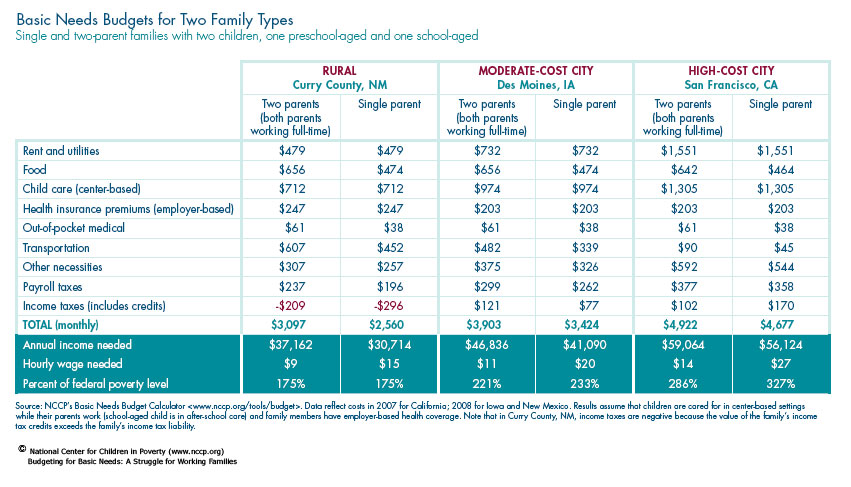
In more moderate-cost cities, the aforementioned family unit needs most $45,000 to $47,000 a year to encompass the cost of twenty-four hours-to-twenty-four hours necessities. Des Moines, Detroit, San Antonio, and Tampa fall into this range. The cost of living is typically less in rural areas, though there is wide variation across the country.
In the low-toll rural areas of Alamosa Canton, CO, Back-scratch County, NM, and Eastward Carroll Parish, LA, a two-parent family with two children can brand ends run across with an income of $35,000 to $37,000 a year. In rural Grays Harbor Canton, WA, a Basic Needs Budget for this family is higher: $41,000 a year, or ii full-time, year-round jobs paying $10 an hour.
For a unmarried parent, making ends meet presents an fifty-fifty greater claiming. While family expenses are somewhat lower, there is only i worker to shoulder the cost. As seen in Figure ane, a single parent with two children needs to earn $15 an hour to afford basic necessities in a rural area of New United mexican states, $20 an hour in Des Moines, and $27 in San Francisco.
The Day-to-Day Struggle
Monica and Sam Patterson alive in Des Moines with their two daughters. Both parents are employed full-time and earn $10 per 60 minutes. Together, their income totals about $42,000 a year before taxes, and Monica's job provides affordable family health insurance. The Pattersons rent a modest ii-sleeping room apartment, rarely employ their cars except to commute to work, and never exit to swallow. The younger daughter, who is three, goes to a child care heart while her parents work; the older daughter is in afterward-school care.
Despite working full time, Monica and Sam cannot brand ends run into. Without enough money to cover the toll of rent, nutrient, child care, wellness intendance, transportation, and other necessities (come across box), Monica and Sam are forced to compromise on the basics. Moreover, whatever unexpected expense or small loss in wages – due to an illness or car trouble, for instance – leaves them in the scarlet.
Basic Needs Budget for the Patterson Family unit
| Annual | Monthly | |
|---|---|---|
| Rent and Utilities | $eight,784 | $732 |
| Food | $7,878 | $656 |
| Child Care (center-based) | $eleven,682 | $974 |
| Health Insurance (employer-based) | $ii,436 | $203 |
| Out-of-pocket medical | $732 | $61 |
| Transportation | $5,788 | $482 |
| Other Necessities | $4,499 | $375 |
| Debt | $0 | $0 |
| Payroll | $3,583 | $299 |
| Income Taxes (includes credits) | $1,455 | $121 |
| Total | $46,836 | $iii,903 |
| Hourly wage needed (per parent): $xi Percent of the federal poverty level: 221% | ||
Where does the money get?
Basic Needs Budgets include just day-to-solar day necessities: housing, food, transportation, child intendance, wellness intendance, payroll and income taxes, and a little more for other necessities such equally habiliment and schoolhouse supplies. They exercise non include durable appurtenances – such equally piece of furniture or household appliances – nor enrichment activities, entertainment, or other expenses that meliorate a family'south quality of life. They do non allow for investments in a family unit's time to come, such as savings for a habitation, a child'south education, or a parent's retirement. And they do not provide any resource to pay off debt nor a fiscal cushion to withstand a crisis. Nonetheless, fifty-fifty these budgets are across the reach of many working families.
Kid care is often the unmarried largest expense that families face up. This is truthful in nearly ninety percent of NCCP'south Basic Needs Budgets for a family unit with a preschool-aged and a schoolhouse-aged child (assuming children are cared for in a center-based setting). Other enquiry confirms that in 49 states, the cost of child care for two children of whatever age exceeds median hire costs. Depending on where a family lives, the cost of care for ane preschool-aged and one school-aged child can range from under $600 a calendar month to more $i,500 – or about $7,000 to $20,000 a year. Equally seen in Effigy ii, that'south about 20 to 35 percent of a total Bones Needs Budget. (Note that the budgets presented in Figure 2 presume that family members have employer-based health insurance; see more than on this issue beneath.)
After the cost of child care, housing is generally families' next largest expense, with rent and utilities comprising about xx pct of a family's total basic budget. Nutrient and transportation are significant costs also, rivaling the cost of housing in some places. Transportation costs can be especially crushing in rural areas where parents ofttimes take to drive long distances to reach their jobs. In some of the highest toll cities, on the other hand, public transportation makes commuting much more affordable.
Taxes tin take a large seize with teeth out of families' budgets as well, and for families who are just barely making ends run across, payroll taxes are nigh always higher than income taxes. In part this is because income taxes are outset by tax credits, such every bit the federal Earned Income Tax Credit, the Child Tax Credit, and the Child and Dependent Care Tax Credit, likewise equally similar state- and local-level credits. Basic Needs Budgets presume that families receive all of the income tax credits for which they are eligible. Information technology is important to annotation that other types of land and local taxes – such every bit sales and excise taxes – are non reflected in these budgets.
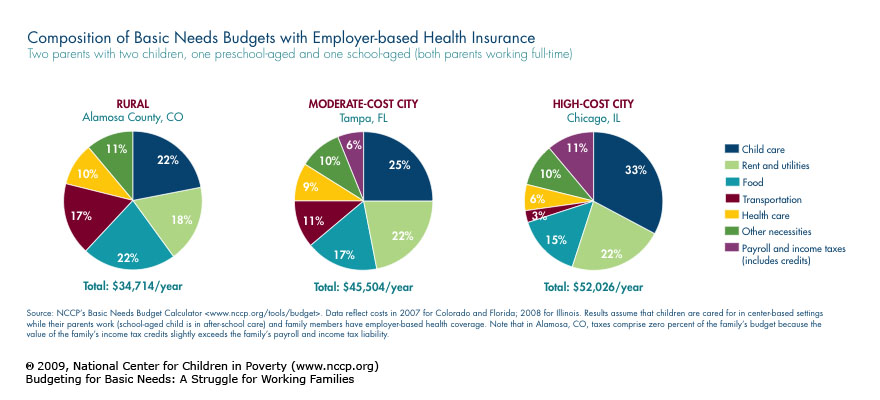
Finally, the cost of health insurance is relatively low in Figure 2 – nigh five to 10 percent of a family'southward total upkeep – because these budgets assume that the family has employer-based health coverage. In exercise, employer-based health plans are becoming increasingly unavailable, and the majority of depression-income workers lack such benefits.
As seen in Figure 3, Basic Needs Budgets for families who do not have employer-based health benefits look significantly different. The budgets shown here are the aforementioned every bit those in Figure ii with one exception: they assume that family members exercise not have admission to employer-based health benefits and must purchase coverage on the open up market.
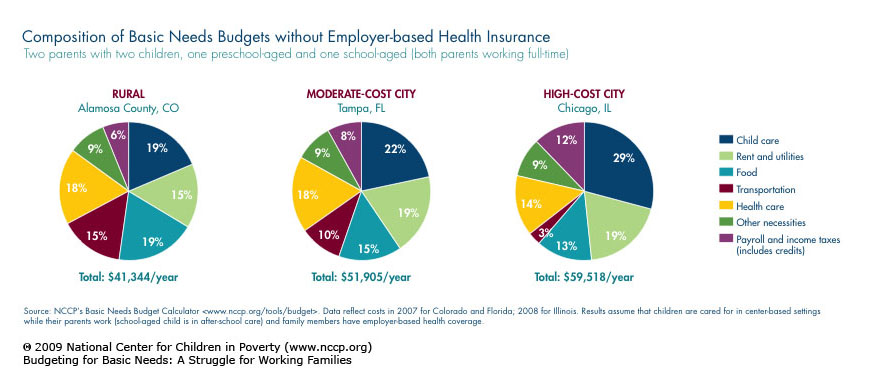
Private, nongroup health insurance tin can cost as much equally – or even more – rent. The high cost of coverage not but consumes a big portion of a family's budget, but also has a substantial impact on budget totals. In Alamosa Canton, assuming nongroup versus employer-based wellness coverage increases the size of the family's upkeep past well-nigh 20 percent, from $35,000 to $41,000 a year. In Chicago, the toll of bones necessities for ii parents with ii children rises from $52,000 to $60,000 a year. In practice, the high cost of nongroup coverage means that many depression- and moderate-income workers detect themselves and their family members uninsured.
What if one parent stays home?
While single parents are both the chief breadwinners and primary caretakers for their families, two-parent families potentially have more options as they seek to balance the demands of work and family. One parent may take a part-time job, for example, or stay home full-time to treat the children. Basic Needs Budgets show that by reducing or eliminating the need for child care, this can significantly bring down the family'southward expenses. Transportation costs are besides lower without two full-fourth dimension commutes, and families with lower earnings owe less in taxes. (See Figure iv; annotation that these budgets assume employer-based health insurance.)
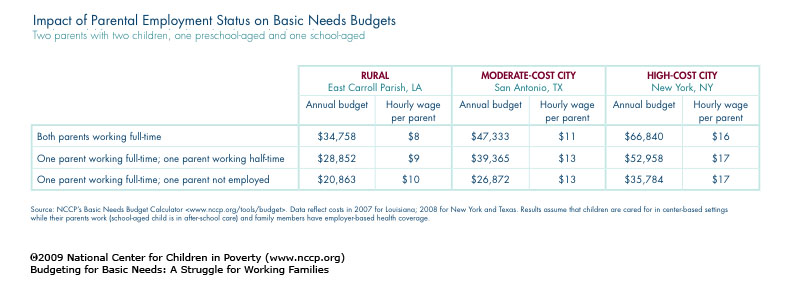
But despite reduced expenses when ane parent stays domicile full- or part-time, a college hourly wage is needed to make ends meet. In San Antonio, for case, a ii-parent family with two children can cover a bones budget if both parents work total-fourth dimension, earning $11 an hour each. But with just one parent employed full-time, that parent needs to earn $13 an hour. In exercise, in two-thirds of the country's ii-parent families, both parents are employed.
Interestingly, Basic Needs Budgets indicate that families with one total-time worker may need the same hourly wage, whether the second parent is employed one-half-time or non at all. This is because the additional earnings from a role-fourth dimension job can be canceled out by the resultant increases in child care and other work-related expenses.
How do family unit budgets modify equally children grow older?
The analyses higher up are based on families with one preschool-anile kid and one schoolhouse-aged child. As children grow older, families' expenses change. Most significantly, older children generally need less child intendance. The result is that a two-parent family with 2 children needs more than to brand ends meet when both children are preschool-anile, for example, than when i enters schoolhouse (run into Figure 5). At the same time, parents with the youngest children are likely to earn the least – and this is as well when the impact of economic hardship tin be virtually devastating for children'due south development.
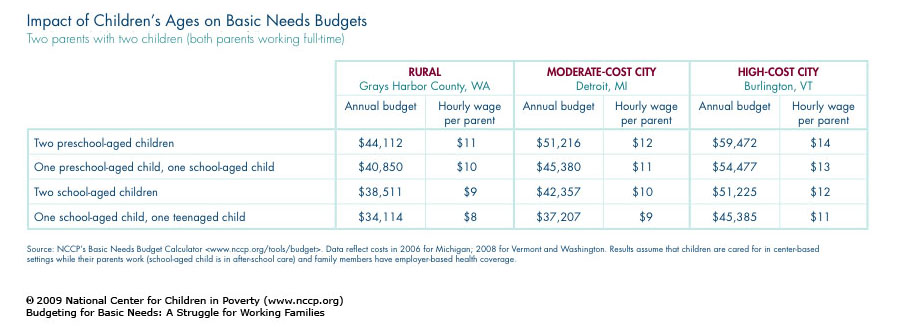
Effigy 5 also shows that fifty-fifty families with one school-aged child (under age 13) and one teenager need two full-fourth dimension jobs paying well above the federal minimum wage only to comprehend 24-hour interval-to-mean solar day necessities. To salvage for their children's college education or for their own retirement, parents need to earn far more. Finally, Figure 5 looks at wages for families with two full-time earners.
A single parent needs a much college-paying job to make ends come across, regardless of her children's ages. In Detroit, for example, a unmarried parent with two preschool-aged children needs to earn $47,000 a year just to cover bones expenses. That's the equivalent of full-time, year-round employment at $22 an hour. With ane school-aged kid and ane teenager, the cost of bones family expenses falls, simply the parent still needs a $fifteen-an-hour task to beget minimum day-to-day necessities.
What does this mean for America'southward families?
Millions of America's families scrape past on less than what it takes to embrace their basic needs. Parents may find cheaper, but potentially less reliable and lower quality, care for their children. They may live in overcrowded housing or in unsafe neighborhoods – or go behind on rent or utility bills. These are tough choices that jeopardize the well-being of our nation's children and families.
America's families demand access to high quality jobs with decent wages and benefits. They also need a comprehensive work back up system designed to accost the challenges faced by those who struggle to afford basic necessities, despite working full-time. And that struggle is simply growing as the cost of basics, such every bit nutrient and health intendance, rises.
Endnotes
1. This effigy is from the federal poverty guidelines, issued by the U.S. Section of Health and Man Services and used for benefit eligibility determinations and other administrative purposes. The poverty thresholds issued by the U.South. Census Agency, which are used for enquiry and statistical purposes, differ slightly. For more information, run across world wide web.aspe.hhs.gov/ POVERTY/09poverty.shtml.
ii. Here and beneath, a "school-age kid" refers to a child ages 6 through 12 years. For a detailed description of how the cost of basic family needs is estimated, encounter "Basic Needs Budget Methodology."
three. Breaking the Piggy-Depository financial institution: Parents and the Loftier Price of Child Care. 2006. Arlington, VA: National Clan of Child Care Resources and Referral Agencies.
4. Clemans-Cope, Lisa; Garrett, Bowen; Hoffman, Catherine. 2006. Changes in Employees' Health Insurance Coverage, 2001-2005. Washington, DC: Kaiser Commission on Medicaid and the Uninsured, Henry J. Kaiser Family unit Foundation.
5. Gould, Elise. 2008. The Erosion of Employer-Sponsored Wellness Insurance: Declines Continue for the Seventh Twelvemonth. Washington, DC: Economic Policy Institute.
6. NCCP assay based on the U.S. Current Population Survey, Annual Social and Economic Supplements, March 2008 representing information for calendar year 2007.
7. In reality, the child care needs of families with two working parents vary significantly based on parents' work patterns. Basic Needs Budgets assume that in families with two employed parents, parents' work schedules overlap. Family kid care needs are estimated based on the work hours of the parent who works the fewest hours.
8. Basic Needs Budgets assume that school-aged children (ages half-dozen through 12) need well-nigh half the amount of care needed past preschool-aged children, while children over age 12 practice non need child intendance.
9. Parents with younger children are likely to be younger themselves and thus earn less than parents with older children. For more than on the impact of economic hardship on young children, come across Knitzer, Jane. 2007. Testimony on the Economic and Societal Costs of Poverty. Prepared for the Commission on Means and Means, House of Representatives.
ten. Cauthen, Nancy K.; Fass, Sarah. 2008. 10 Important Questions about Child Poverty and Family Economic Hardship. New York, NY: National Centre for Children in Poverty, Columbia University, Mailman School of Public Wellness.
11. NCCP's Making Work Supports Work project seeks to promote a comprehensive national work support arrangement that enables full-time workers to provide for their families and ensures that earning more always improves a family's fiscal bottom line. For more than, see the Making Work Supports Work projection. For a discussion of a comprehensive arroyo to work supports, see Cauthen, Nancy K. 2007. Improving Piece of work Supports: Endmost the Financial Gap for Low-Wage Workers and Their Families. Washington, DC: Agenda for Shared Prosperity, Economical Policy Institute.
Download PDF
[wpforms id="3945"]
<div class="wpforms-container wpforms-container-full" id="wpforms-3945"><form id="wpforms-form-3945" class="wpforms-validate wpforms-course wpforms-ajax-class" data-formid="3945" method="postal service" enctype="multipart/form-data" action="/publication/budgeting-for-bones-needs-a-struggle-for-working-families/" data-token="702595ad7009b07649795b03a88cf5cf"><noscript class="wpforms-error-noscript">Please enable JavaScript in your browser to complete this form.</noscript><div class="wpforms-field-container"><div id="wpforms-3945-field_7-container" class="wpforms-field wpforms-field-radio" data-field-id="7"><label class="wpforms-field-label" for="wpforms-3945-field_7">Thank you for visiting PRiSM. Please let us know who you lot are:</characterization><ul id="wpforms-3945-field_7"><li class="choice-1 depth-1"><input type="radio" id="wpforms-3945-field_7_1" name="wpforms[fields][7]" value="State advocacy/policy organization" ><label course="wpforms-field-characterization-inline" for="wpforms-3945-field_7_1">Country advocacy/policy system</label></li><li class="choice-2 depth-1"><input type="radio" id="wpforms-3945-field_7_2" name="wpforms[fields][7]" value="National arrangement" ><characterization class="wpforms-field-label-inline" for="wpforms-3945-field_7_2">National organization</label></li><li class="option-three depth-1"><input type="radio" id="wpforms-3945-field_7_3" name="wpforms[fields][7]" value="Government agency" ><label grade="wpforms-field-label-inline" for="wpforms-3945-field_7_3">Government agency</characterization></li><li class="choice-5 depth-ane"><input type="radio" id="wpforms-3945-field_7_5" name="wpforms[fields][7]" value="Legislative office" ><label course="wpforms-field-characterization-inline" for="wpforms-3945-field_7_5">Legislative office</label></li><li class="selection-iv depth-i"><input type="radio" id="wpforms-3945-field_7_4" name="wpforms[fields][seven]" value="Researcher" ><label class="wpforms-field-characterization-inline" for="wpforms-3945-field_7_4">Researcher</label></li><li class="selection-half dozen depth-ane"><input blazon="radio" id="wpforms-3945-field_7_6" name="wpforms[fields][7]" value="Other (please describe below)" ><label class="wpforms-field-label-inline" for="wpforms-3945-field_7_6">Other (delight describe below)</label></li></ul></div><div id="wpforms-3945-field_10-container" course="wpforms-field wpforms-field-text" data-field-id="10"><input type="text" id="wpforms-3945-field_10" class="wpforms-field-medium" name="wpforms[fields][10]" ></div><div id="wpforms-3945-field_9-container" class="wpforms-field wpforms-field-text" information-field-id="ix"><label class="wpforms-field-label" for="wpforms-3945-field_9">If you would like alerts almost regular updates to PRiSM, please provide an electronic mail:</label><input type="text" id="wpforms-3945-field_9" form="wpforms-field-small" proper noun="wpforms[fields][nine]" ></div></div><div class="wpforms-submit-container"><input blazon="hidden" name="wpforms[id]" value="3945"><input type="subconscious" name="wpforms[author]" value="148"><input type="subconscious" name="wpforms[post_id]" value="1808"><button type="submit" name="wpforms[submit]" id="wpforms-submit-3945" class="wpforms-submit om-trigger-conversion" data-alt-text="Sending..." data-submit-text="Submit" aria-live="assertive" value="wpforms-submit">Submit</push button><img src="https://www.nccp.org/wp-content/plugins/wpforms/assets/images/submit-spin.svg" class="wpforms-submit-spinner" style="display: none;" width="26" height="26" alt=""></div></class></div> <!-- .wpforms-container -->
[wpforms id="3933"]
<div form="wpforms-container wpforms-container-total" id="wpforms-3933"><form id="wpforms-form-3933" class="wpforms-validate wpforms-course wpforms-ajax-form" data-formid="3933" method="postal service" enctype="multipart/form-data" activity="/publication/budgeting-for-bones-needs-a-struggle-for-working-families/" information-token="c463c9eff3ea2c1b07a1dc93a29928e3"><noscript grade="wpforms-error-noscript">Please enable JavaScript in your browser to complete this form.</noscript><div class="wpforms-field-container"><div id="wpforms-3933-field_7-container" class="wpforms-field wpforms-field-radio" data-field-id="7"><label class="wpforms-field-label" for="wpforms-3933-field_7">Thank you for visiting our EC Profiles. Please let us know who y'all are:</label><ul id="wpforms-3933-field_7"><li grade="choice-1 depth-1"><input blazon="radio" id="wpforms-3933-field_7_1" name="wpforms[fields][vii]" value="State advocacy/policy organization" ><label course="wpforms-field-characterization-inline" for="wpforms-3933-field_7_1">State advocacy/policy organisation</characterization></li><li class="choice-two depth-i"><input blazon="radio" id="wpforms-3933-field_7_2" name="wpforms[fields][vii]" value="National organization" ><label class="wpforms-field-label-inline" for="wpforms-3933-field_7_2">National organization</label></li><li class="pick-3 depth-1"><input type="radio" id="wpforms-3933-field_7_3" name="wpforms[fields][7]" value="Government bureau" ><label class="wpforms-field-label-inline" for="wpforms-3933-field_7_3">Government agency</label></li><li class="selection-5 depth-i"><input type="radio" id="wpforms-3933-field_7_5" proper name="wpforms[fields][7]" value="Legislative office" ><label course="wpforms-field-label-inline" for="wpforms-3933-field_7_5">Legislative function</label></li><li course="selection-iv depth-one"><input blazon="radio" id="wpforms-3933-field_7_4" name="wpforms[fields][7]" value="Researcher" ><label class="wpforms-field-label-inline" for="wpforms-3933-field_7_4">Researcher</characterization></li><li form="choice-6 depth-1"><input blazon="radio" id="wpforms-3933-field_7_6" name="wpforms[fields][vii]" value="Other (please describe beneath)" ><characterization grade="wpforms-field-label-inline" for="wpforms-3933-field_7_6">Other (delight describe below)</label></li></ul></div><div id="wpforms-3933-field_10-container" grade="wpforms-field wpforms-field-text" information-field-id="10"><input blazon="text" id="wpforms-3933-field_10" form="wpforms-field-medium" name="wpforms[fields][ten]" ></div><div id="wpforms-3933-field_9-container" form="wpforms-field wpforms-field-text" information-field-id="9"><label class="wpforms-field-label" for="wpforms-3933-field_9">If you would like alerts nearly regular updates to these profiles, delight provide an email:</label><input type="text" id="wpforms-3933-field_9" course="wpforms-field-medium" name="wpforms[fields][9]" ></div></div><div grade="wpforms-submit-container"><input type="hidden" name="wpforms[id]" value="3933"><input type="subconscious" name="wpforms[author]" value="148"><input blazon="hidden" proper name="wpforms[post_id]" value="1808"><button type="submit" name="wpforms[submit]" id="wpforms-submit-3933" class="wpforms-submit om-trigger-conversion" data-alt-text="Sending..." data-submit-text="Submit" aria-live="assertive" value="wpforms-submit">Submit</button><img src="https://www.nccp.org/wp-content/plugins/wpforms/assets/images/submit-spin.svg" course="wpforms-submit-spinner" style="display: none;" width="26" elevation="26" alt=""></div></form></div> <!-- .wpforms-container -->
Source: https://www.nccp.org/publication/budgeting-for-basic-needs-a-struggle-for-working-families/
0 Response to "Low Income Families Spending Housing Child Care Transportation"
Post a Comment