How Do You Know That Youve Chosen Just the Right Spot to Plant a Lighthouse

A lighthouse is a belfry, building, or other type of construction designed to emit low-cal from a system of lamps and lenses and to serve every bit a beacon for navigational aid, for maritime pilots at ocean or on inland waterways.
Lighthouses mark unsafe coastlines, hazardous shoals, reefs, rocks, and safe entries to harbors; they as well help in aerial navigation. Once widely used, the number of operational lighthouses has declined due to the expense of maintenance and has get uneconomical since the advent of much cheaper, more sophisticated and effective electronic navigational systems.
History [edit]
Aboriginal lighthouses [edit]
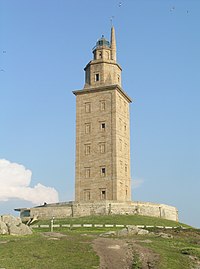
Before the development of clearly defined ports, mariners were guided by fires built on hilltops. Since elevating the burn would amend the visibility, placing the burn down on a platform became a exercise that led to the development of the lighthouse.[ane] In antiquity, the lighthouse functioned more than every bit an entrance marker to ports than as a warning signal for reefs and promontories, different many modernistic lighthouses. The well-nigh famous lighthouse structure from antiquity was the Pharos of Alexandria, Egypt, which collapsed following a serial of earthquakes between 956 CE and 1323 CE.
The intact Belfry of Hercules at A Coruña, Spain gives insight into ancient lighthouse construction; other evidence virtually lighthouses exists in depictions on coins and mosaics, of which many represent the lighthouse at Ostia. Coins from Alexandria, Ostia, and Laodicea in Syria also exist.
Modern construction [edit]
The modern era of lighthouses began at the turn of the 18th century, as the number of lighthouses being constructed increased significantly due to much higher levels of transatlantic commerce. Advances in structural engineering and new and efficient lighting equipment allowed for the creation of larger and more than powerful lighthouses, including ones exposed to the sea. The role of lighthouses was gradually changed from indicating ports to the providing of a visible warning confronting shipping hazards, such as rocks or reefs.
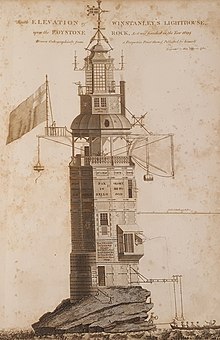
The Eddystone Rocks were a major shipwreck risk for mariners sailing through the English Channel.[2] The first lighthouse congenital there was an octagonal wooden structure, anchored by 12 iron stanchions secured in the stone, and was congenital by Henry Winstanley from 1696 to 1698. His lighthouse was the first tower in the world to have been fully exposed to the open sea.[3]
The civil engineer John Smeaton rebuilt the lighthouse from 1756 to 1759;[4] his tower marked a major step forward in the design of lighthouses and remained in use until 1877. He modeled the shape of his lighthouse on that of an oak tree, using granite blocks. He rediscovered and used "hydraulic lime", a class of concrete that volition set under water used by the Romans, and adult a technique of securing the granite blocks together using dovetail joints and marble dowels.[five] The dovetailing feature served to amend the structural stability, although Smeaton also had to taper the thickness of the tower towards the top, for which he curved the belfry inwards on a gentle gradient. This contour had the added advantage of allowing some of the energy of the waves to dissipate on touch on with the walls. His lighthouse was the prototype for the modern lighthouse and influenced all subsequent engineers.[6]
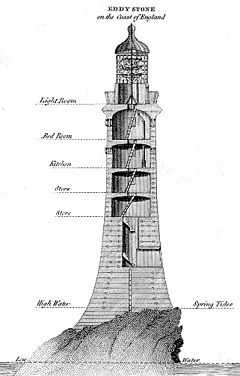
I such influence was Robert Stevenson, himself a seminal effigy in the development of lighthouse design and construction.[vii] His greatest achievement was the construction of the Bell Rock Lighthouse in 1810, ane of the most impressive feats of applied science of the age.[ citation needed ] This structure was based upon Smeaton's design, but with several improved features, such every bit the incorporation of rotating lights, alternating between ruddy and white.[8] Stevenson worked for the Northern Lighthouse Board for almost 50 years[7] during which time he designed and oversaw the construction and later improvement of numerous lighthouses. He innovated in the choice of low-cal sources, mountings, reflector design, the use of Fresnel lenses, and in rotation and shuttering systems providing lighthouses with private signatures allowing them to be identified past seafarers. He also invented the movable jib and the balance-crane equally a necessary part for lighthouse structure.

Alexander Mitchell designed the first spiral-pile lighthouse – his lighthouse was congenital on piles that were screwed into the sandy or muddy seabed. Construction of his pattern began in 1838 at the mouth of the Thames and was known as the Maplin Sands lighthouse, and starting time lit in 1841.[9] Although its construction began later, the Wyre Light in Fleetwood, Lancashire, was the first to be lit (in 1840).[nine]
Lighting improvements [edit]
Until 1782 the source of illumination had generally been wood pyres or burning coal. The Argand lamp, invented in 1782 past the Swiss scientist Aimé Argand revolutionized lighthouse illumination with its steady smokeless flame. Early models used ground drinking glass which was sometimes tinted around the wick. Later models used a pall of thorium dioxide suspended over the flame, creating a bright, steady light.[10] The Argand lamp used whale oil, colza, olive oil[11] or other vegetable oil equally fuel, supplied past a gravity feed from a reservoir mounted above the burner. The lamp was first produced by Matthew Boulton, in partnership with Argand, in 1784, and became the standard for lighthouses for over a century.[12]
Southward Foreland Lighthouse was the beginning tower to successfully utilize an electrical low-cal in 1875. The lighthouse's carbon arc lamps were powered past a steam-driven magneto.[thirteen] John Richardson Wigham was the first to develop a arrangement for gas illumination of lighthouses. His improved gas 'crocus' burner at the Baily Lighthouse near Dublin was 13 times more powerful than the virtually brilliant light then known.[14]
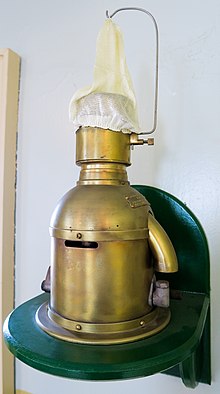
An 85 millimetres (iii.3 in) Chance Brothers Incandescent Petroleum Vapour Installation which produced the light for the Sumburgh Head lighthouse until 1976. The lamp (made in approx. 1914) burned vaporized kerosene (paraffin); the vaporizer was heated by a denatured alcohol (methylated spirit) burner to light. When lit, some of the vaporised fuel was diverted to a Bunsen burner to keep the vaporizer warm and the fuel in vapor class. The fuel was forced up to the lamp by air; the keepers had to pump the air container up every hour or then, pressurizing the paraffin container to force the fuel to the lamp. The "white sock" pictured is an unburnt drapery on which the vapor burned.
The vaporized oil burner was invented in 1901 by Arthur Kitson, and improved past David Hood at Trinity Firm. The fuel was vaporized at high pressure and burned to heat the drapery, giving an output of over six times the luminosity of traditional oil lights. The apply of gas as illuminant became widely bachelor with the invention of the Dalén light by Swedish engineer Gustaf Dalén. He used Agamassan (Aga), a substrate, to absorb the gas, allowing the gas to be stored, and hence used, safely. Dalén also invented the 'sun valve', which automatically regulated the light and turned it off during the daytime.[ citations needed ] The engineering was the predominant calorie-free source in lighthouses from the 1900s to the 1960s, when electric lighting had become dominant.[15]
Optical systems [edit]

Diagram depicting how a spherical Fresnel lens collimates low-cal
With the development of the steady illumination of the Argand lamp, the awarding of optical lenses to increase and focus the light intensity became a practical possibility. William Hutchinson developed the starting time practical optical system in 1763, known every bit a catoptric system.[ citation needed ] This rudimentary system effectively collimated the emitted calorie-free into a concentrated beam, thereby greatly increasing the low-cal'due south visibility.[16] The ability to focus the light led to the beginning revolving lighthouse beams, where the light would appear to the mariners as a serial of intermittent flashes. It also became possible to transmit circuitous signals using the light flashes.
French physicist and engineer Augustin-Jean Fresnel developed the multi-role Fresnel lens for use in lighthouses. His design immune for the construction of lenses of large aperture and brusk focal length, without the mass and volume of textile that would be required by a lens of conventional design. A Fresnel lens tin can be fabricated much thinner than a comparable conventional lens, in some cases taking the course of a flat sheet. A Fresnel lens can also capture more oblique low-cal from a low-cal source, thus allowing the lite from a lighthouse equipped with one to be visible over greater distances.
The commencement Fresnel lens was used in 1823 in the Cordouan lighthouse at the mouth of the Gironde estuary; its low-cal could exist seen from more than 20 miles (32 km) out.[17] Fresnel's invention increased the luminosity of the lighthouse lamp by a factor of four and his system is withal in common use.
Modern lighthouses [edit]
The introduction of electrification and automatic lamp changers began to make lighthouse keepers obsolete. For many years, lighthouses still had keepers, partly because lighthouse keepers could serve as a rescue service if necessary. Improvements in maritime navigation and safety such every bit satellite navigation systems such equally GPS led to the phasing out of not-automated lighthouses across the globe.[eighteen] In Canada, this trend has been stopped and in that location are however 50 staffed light stations, with 27 on the westward declension lone.[xix]
Remaining modernistic lighthouses are usually illuminated past a single stationary flashing light powered by solar-charged batteries mounted on a steel skeleton tower.[twenty] Where the power requirement is likewise great for solar power, cycle charging by diesel generator is used: to save fuel and to increase periods between maintenance the light is battery powered, with the generator only coming into utilise when the battery has to be charged.[21]
Famous lighthouse builders [edit]
John Smeaton is noteworthy for having designed the third and most famous Eddystone Lighthouse, but some builders are well known for their work in building multiple lighthouses. The Stevenson family (Robert, Alan, David, Thomas, David Alan, and Charles) made lighthouse edifice a 3-generation profession in Scotland. Richard Henry Brunton designed and congenital 26 Japanese lighthouses in Meiji Era Japan, which became known as Brunton's "children".[22] Blind Irishman Alexander Mitchell invented and built a number of screw-pile lighthouses. Englishman James Douglass was knighted for his piece of work on the fourth Eddystone Lighthouse.[23]
United States Army Corps of Engineers Lieutenant George Meade built numerous lighthouses along the Atlantic and Gulf coasts before gaining wider fame equally the winning general at the Battle of Gettysburg. Colonel Orlando M. Poe, engineer to General William Tecumseh Sherman in the Siege of Atlanta, designed and built some of the almost exotic lighthouses in the nigh difficult locations on the U.Southward. Great Lakes.[24]
French merchant navy officeholder Marius Michel Pasha built almost a hundred lighthouses along the coasts of the Ottoman Empire in a menstruation of 20 years after the Crimean State of war (1853–1856).[25]
Engineering science [edit]
In a lighthouse, the source of light is called the "lamp" (whether electric or fuelled by oil) and the light is concentrated, if needed, by the "lens" or "optic". Power sources for lighthouses in the 20th–21st centuries vary.
Ability [edit]
Originally lit by open fires and after candles, the Argand hollow wick lamp and parabolic reflector were introduced in the late 18th century.
Whale oil was also used with wicks equally the source of light. Kerosene became popular in the 1870s and electricity and carbide (acetylene gas) began replacing kerosene around the plough of the 20th century.[20] Carbide was promoted by the Dalén light which automatically lit the lamp at nightfall and extinguished it at dawn.
During the Cold War, many remote Soviet lighthouses were powered by radioisotope thermoelectric generators (RTGs). These had the advantage of providing ability twenty-four hour period or nighttime and did not need refuelling or maintenance. However, after the breakdown of the Soviet Union, there are no official records of the locations or condition of all of these lighthouses.[26] As time passes, their condition is degrading; many have fallen victim to vandalism and chip metal thieves, who may not be aware of the dangerous radioactive contents.[27]
Energy-efficient LED lights tin can be powered by solar panels, with batteries instead of a diesel fuel generator for fill-in.[28]
Light source [edit]
Many Fresnel lens installations have been replaced by rotating aerobeacons which crave less maintenance.
In modernistic automated lighthouses, the system of rotating lenses is often replaced past a loftier intensity light that emits cursory omnidirectional flashes, concentrating the light in time rather than direction. These lights are similar to obstruction lights used to warn aircraft of alpine structures. Later innovations were "Vega Lights", and experiments with lite-emitting diode (LED) panels.[20]
LED lights, which utilise less energy and are easier to maintain, had come into widespread use past 2020. In the U.k. and Ireland nearly a third of lighthouses had been converted from filament calorie-free sources to use LEDs, and conversion connected with nearly three per yr. The calorie-free sources are designed to replicate the colour and character of the traditional calorie-free as closely as possible. The modify is ofttimes not noticed by people in the region, only sometimes a proposed change leads to calls to preserve the traditional light, including in some cases a rotating beam. A typical LED system designed to fit into the traditional 19th century Fresnel lens enclosure was developed by Trinity Firm and ii other lighthouse authorities and costs about €xx,000, depending on configuration, according to a supplier; it has big fins to misemploy heat. Lifetime of the LED low-cal source is 50,000 to 100,000 hours, compared to about 1,000 hours for a filament source.[28]
Light amplification by stimulated emission of radiation light [edit]
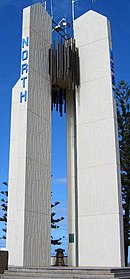
Experimental installations of light amplification by stimulated emission of radiation lights, either at high power to provide a "line of light" in the sky or, utilising low power, aimed towards mariners have identified issues of increased complexity in installation and maintenance, and high power requirements. The first practical installation, in 1971 at Point Danger lighthouse, Queensland, was replaced by a conventional light afterward iv years because the beam was besides narrow to be seen easily.[29] [30]
Lite characteristics [edit]
In any of these designs an observer, rather than seeing a continuous weak calorie-free, sees a brighter light during short time intervals. These instants of brilliant lite are bundled to create a low-cal characteristic or design specific to a lighthouse.[31] For example, the Scheveningen Lighthouse flashes are alternately 2.v and 7.5 seconds. Some lights have sectors of a particular color (usually formed past colored panes in the lantern) to distinguish safe water areas from dangerous shoals. Mod lighthouses ofttimes have unique reflectors or Racon transponders so the radar signature of the low-cal is likewise unique.
Lens [edit]

Before modernistic strobe lights, lenses were used to concentrate the lite from a continuous source. Vertical light rays of the lamp are redirected into a horizontal plane, and horizontally the lite is focused into one or a few directions at a time, with the light beam swept effectually. As a event, in addition to seeing the side of the light axle, the low-cal is directly visible from greater distances, and with an identifying low-cal feature.
This concentration of light is accomplished with a rotating lens associates. In early on lighthouses, the light source was a kerosene lamp or, earlier, an animal or vegetable oil Argand lamp, and the lenses rotated by a weight driven clockwork assembly wound by lighthouse keepers, sometimes every bit often as every 2 hours. The lens assembly sometimes floated in liquid mercury to reduce friction. In more than modernistic lighthouses, electric lights and motor drives were used, by and large powered by diesel electric generators. These as well supplied electricity for the lighthouse keepers.[20]
Efficiently concentrating the light from a large omnidirectional calorie-free source requires a very large diameter lens. This would require a very thick and heavy lens if a conventional lens were used. The Fresnel lens (pronounced ) focused 85% of a lamp's light versus the xx% focused with the parabolic reflectors of the time. Its blueprint enabled construction of lenses of large size and short focal length without the weight and volume of textile in conventional lens designs.[32]
Fresnel lighthouse lenses are ranked by order, a measure out of refracting power, with a first order lens being the largest, most powerful and expensive; and a 6th order lens beingness the smallest. The order is based on the focal length of the lens. A kickoff club lens has the longest focal length, with the sixth being the shortest. Littoral lighthouses generally utilise first, second, or third order lenses, while harbor lights and beacons employ fourth, fifth, or sixth order lenses.[33]
Some lighthouses, such as those at Cape Race, Newfoundland, and Makapuu Point, Hawaii, used a more powerful hyperradiant Fresnel lens manufactured by the firm of Risk Brothers.
Building [edit]
Components [edit]

Lighthouse lantern room from mid-1800s
While lighthouse buildings differ depending on the location and purpose, they tend to have common components.
A lite station comprises the lighthouse tower and all outbuildings, such as the keeper'south living quarters, fuel house, boathouse, and fog-signaling edifice. The Lighthouse itself consists of a tower structure supporting the lantern room where the calorie-free operates.
The lantern room is the glassed-in housing at the top of a lighthouse tower containing the lamp and lens. Its glass storm panes are supported by metallic muntins (glazing confined) running vertically or diagonally. At the top of the lantern room is a stormproof ventilator designed to remove the smoke of the lamps and the heat that builds in the drinking glass enclosure. A lightning rod and grounding system connected to the metal cupola roof provides a rubber conduit for whatever lightning strikes.
Immediately beneath the lantern room is unremarkably a Lookout Room or Service Room where fuel and other supplies were kept and where the keeper prepared the lanterns for the night and ofttimes stood watch. The clockworks (for rotating the lenses) were also located in that location. On a lighthouse tower, an open platform called the gallery is ofttimes located outside the scout room (called the Main Gallery) or Lantern Room (Lantern Gallery). This was mainly used for cleaning the outside of the windows of the Lantern Room.[34]
Lighthouses near to each other that are similar in shape are oft painted in a unique pattern so they can easily be recognized during daylight, a marking known as a daymark. The blackness and white barber pole spiral pattern of Cape Hatteras Lighthouse is one example. Race Rocks Light in western Canada is painted in horizontal blackness and white bands to stand up out against the horizon.
Blueprint [edit]
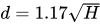
For effectiveness, the lamp must exist high plenty to be seen before the danger is reached past a mariner. The minimum tiptop is calculated by trigonometric formula where H is the height above h2o in feet, and d is the distance to the horizon in nautical miles.[35]
Where dangerous shoals are located far off a flat sandy beach, the prototypical tall masonry coastal lighthouse is constructed to assist the navigator making a landfall after an ocean crossing. Often these are cylindrical to reduce the result of wind on a tall construction, such as Cape May Low-cal. Smaller versions of this design are often used as harbor lights to mark the archway into a harbor, such as New London Harbor Light.
Where a tall cliff exists, a smaller construction may be placed on top such as at Horton Bespeak Light. Sometimes, such a location can be too high, for example along the west coast of the United States, where frequent low clouds tin can obscure the light. In these cases, lighthouses are placed below the clifftop to ensure that they can still be seen at the surface during periods of fog or low clouds, as at Signal Reyes Lighthouse. Another case is in San Diego, California: the Old Point Hill lighthouse was likewise loftier up and often obscured past fog, so it was replaced in 1891 with a lower lighthouse, New Point Loma lighthouse.[ citations needed ]
As technology advanced, prefabricated skeletal iron or steel structures tended to be used for lighthouses constructed in the 20th century. These ofttimes have a narrow cylindrical core surrounded past an open lattice work bracing, such every bit Finns Signal Range Light.
Sometimes a lighthouse needs to exist constructed in the water itself. Wave-washed lighthouses are masonry structures constructed to withstand water impact, such every bit Eddystone Lighthouse in Britain and the St. George Reef Lite of California. In shallower trophy, Spiral-pile lighthouse ironwork structures are screwed into the seabed and a low wooden construction is placed in a higher place the open framework, such every bit Thomas Indicate Shoal Lighthouse. Equally screw piles can be disrupted by ice, steel caisson lighthouses such as Orient Bespeak Light are used in cold climates. Orient Long Beach Bar Light (Bug Calorie-free) is a blend of a screw pile calorie-free that was converted to a caisson light because of the threat of ice damage.[36] Skeletal iron towers with screw-pile foundations were built on the Florida Reef along the Florida Keys, beginning with the Carysfort Reef Low-cal in 1852.[37]
In waters likewise deep for a conventional structure, a lightship might exist used instead of a lighthouse, such every bit the onetime lightship Columbia. Almost of these have now been replaced by stock-still low-cal platforms (such as Ambrose Low-cal) similar to those used for offshore oil exploration.[38]
Range lights [edit]
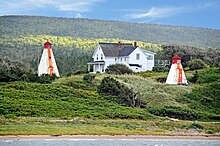
Aligning two fixed points on land provides a navigator with a line of position called a range in North America and a transit in Britain. Ranges can be used to precisely align a vessel inside a narrow channel such equally a river. With landmarks of a range illuminated with a gear up of fixed lighthouses, nighttime navigation is possible.
Such paired lighthouses are called range lights in North America and leading lights in the United Kingdom. The closer light is referred to every bit the beacon or front range; the further light is called the rear range. The rear range light is almost e'er taller than the front end.
When a vessel is on the correct class, the two lights align vertically, but when the observer is out of position, the difference in alignment indicates the direction of travel to right the course.
Location [edit]

There are two types of lighthouses: ones that are located on land, and ones that are offshore. A land lighthouse is simply a lighthouse synthetic to aid navigation over land, rather than water. Historically, they were constructed in areas of flatland where the characterless landscape and prevailing weather atmospheric condition (e.g. winter fog) might cause travelers to become easily disorientated and lost. In such a mural a high tower with a bright lantern could exist visible for many miles.
Ane example of such a structure is Dunston Pillar, an 18th-century tower built to help travelers crossing the heathland of mid-Lincolnshire and to lessen the danger to them from highwaymen. Due to general improvements in transport and navigation throughout the 19th century, land lighthouses became almost totally obsolete as aids to travelers in remote places. In 1940, Dunston Pillar was truncated past 40 feet to preserve low-flying RAF planes.
Offshore Lighthouses are lighthouses that are not shut to land.[39] At that place can be a number of reasons for these lighthouses to be built. There can be a shoal, reef or submerged island several miles from land.
The electric current Cordouan Lighthouse was completed in 1611, 7 kilometres (4.three mi) from the shore on a small islet, simply was congenital on a previous lighthouse that can be traced back to the 880's and is the oldest surviving lighthouse in France. Information technology is connected to the mainland by a causeway. The oldest surviving oceanic offshore lighthouse is Bell Rock Lighthouse in the North Sea, off the declension of Scotland.[xl]
Maintenance [edit]
English-speaking countries [edit]
In the United States, lighthouses are maintained past the Usa Coast Guard (USCG).[41]
The Britain and Republic of ireland together accept 3 bodies: lighthouses around the coasts of England and Wales are looked after by Trinity House, those effectually Scotland and the Mann by the Northern Lighthouse Lath and those around Ireland by the Commissioners of Irish Lights.
In Canada, they are managed past the Canadian Declension Guard.
In Commonwealth of australia, lighthouses are conducted past the Australian Maritime Condom Authority.
Soviet Union [edit]
The Soviet Union built a number of automatic lighthouses powered by radioisotope thermoelectric generators in remote locations. They operated for long periods without external support with peachy reliability.[42] However numerous installations deteriorated, were stolen, or vandalized. Some cannot exist constitute due to poor record-keeping.[43]
India [edit]
In India, lighthouses are maintained past Directorate General of Lighthouses and Lightships which comes under the Ministry of Shipping.[44]
Other countries [edit]
![[icon]](https://upload.wikimedia.org/wikipedia/commons/thumb/1/1c/Wiki_letter_w_cropped.svg/20px-Wiki_letter_w_cropped.svg.png) | This section needs expansion. You can aid by adding to it. (August 2020) |
Preservation [edit]
Equally lighthouses became less essential to navigation, many of their celebrated structures faced demolition or fail. In the United states, the National Historic Lighthouse Preservation Act of 2000 provides for the transfer of lighthouse structures to local governments and private non-profit groups, while the USCG continues to maintain the lamps and lenses. In Canada, the Nova Scotia Lighthouse Preservation Society won heritage status for Sambro Island Lighthouse, and sponsored the Heritage Lighthouse Protection Deed to change Canadian federal laws to protect lighthouses.[45]
Many groups formed to restore and salvage lighthouses effectually the world, including the World Lighthouse Society and the United states Lighthouse Society,[46] besides equally the Apprentice Radio Lighthouse Society, which sends amateur radio operators to publicize the preservation of remote lighthouses throughout the earth.[47]
Meet too [edit]
- Crib lighthouse
- Twenty-four hour period beacon
- Foghorn
- Fresnel lens sizes (orders)
- Lens lantern
- Lighthouse keeper
- Lists of lighthouses
- Lists of lightvessels
- Pharology
- Pintsch gas
- Sea marking
References [edit]
- Notes
- ^ Trethewey, Thou. R.:Ancient Lighthouses, Jazz-Fusion Books (2018), 326pp. ISBN 978-0-99265-736-9
- ^ Smiles, Samuel (1861), The Lives of the Engineers, vol. 2, p. xvi
- ^ "lighthouse". Retrieved 17 December 2012.
- ^ Majdalany, Fred: The Eddystone Light. 1960
- ^ "Eddystone – Gallery". Trinity House. Archived from the original on ix September 2006. Retrieved 3 May 2010.
- ^ Douglass, James Nicholas (1878). "Note on the Eddystone Lighthouse". Minutes of proceedings of the Institution of Civil Engineers. Vol. 53, role 3. London: Institution of Civil Engineers. pp. 247–248.
- ^ a b "NLB – Robert Stevenson". Retrieved 28 Jan 2013.
- ^ Boucher, Cyril Thomas Goodman (1963), John Rennie, 1761–1821: The Life and Work of a Great Engineer, p. 61
- ^ a b Tomlinson, ed. (1852–1854). Tomlinson's Cyclopaedia of Useful Arts. London: Virtue & Co. p. 177.
[Maplin Sands] was not, nevertheless, the first screw-pile lighthouse really erected, for during the long preparation process which was carried on at Maplin Sands, a construction of the aforementioned principle had been begun and completed at Port Fleetwood...
- ^ "Lamp Drinking glass Replacement Drinking glass Lamp Shades, Oil Lamp Shades, Oil Lamp Chimneys, Oil Lamp Spares". Archived from the original on half dozen Jan 2014.
- ^ "Lamp." Encyclopædia Britannica: or, a dictionary of Arts, Science, and Miscellaneous Literature. 6th ed. 1823 Web. 5 December 2011
- ^ "Modern Lighthouses". Encyclopædia Britannica . Retrieved 4 August 2021.
- ^ Baird, Spencer Fullerton (1876). Annual record of scientific discipline and manufacture. New York: Harper & Brothers. p. 460.
- ^ "John Richardson Wigham 1829–1906" (PDF). BEAM. Commissioners of Irish gaelic Lights. 35: 21–22. 2006–2007. Archived from the original (PDF) on 12 March 2012.
- ^ "The Linde Group - Gases Applied science Healthcare -". Archived from the original on 18 October 2015. Retrieved 6 Apr 2017.
- ^ "Lighthouse". Encyclopædia Britannica . Retrieved 6 Jan 2014.
- ^ Watson, Bruce. "Science Makes a Better Lighthouse Lens." Smithsonian. August 1999 v30 i5 p30. produced in Biography Resources Center. Farmington Hills, Mich.: Thomson Gale. 2005.
- ^ "Maritime Heritage Program - National Park Service". Retrieved 6 Apr 2017.
- ^ "Lighthouses of British Columbia". Archived from the original on 3 November 2011. Retrieved three Nov 2011.
- ^ a b c d Crompton & Rhein (2002)
- ^ Nicholson, Christopher (2000). Rock lighthouses of Britain : the cease of an era?. Caithness, Scotland: Whittles. p. 126. ISBN978-1870325417.
- ^ "Obituary - Richard Henry Brunton". Minutes of the Proceedings of the Institution of Civil Engineers. Vol. 145, no. 1901. 1901. pp. 340–341. doi:10.1680/imotp.1901.18577. Retrieved xx Apr 2018.
- ^
 Beare, Thomas Hudson (1901). "Douglass, James Nicholas". Lexicon of National Biography (1st supplement). London: Smith, Elderberry & Co.
 - ^ "Maritime Heritage Program - National Park Service". Retrieved six April 2017.
- ^ Guigueno, Vincent (Jan 2006). "Review of Thobie, Jacques, L'administration generale des phares de fifty'Empire ottoman et la societe Collas et Michel, 1860–1960. H-Mediterranean, H-Net Reviews. January, 2006". Humanities and Social Sciences Cyberspace Online. Retrieved twenty September 2010.
- ^ lighthouses
- ^ deadly
- ^ a b Baraniuk, Chris (15 September 2020). "When changing a light bulb is a really big deal". BBC News.
{{cite web}}: CS1 maint: url-condition (link) - ^ "Point Danger Lighthouse". Lighthouses of Australia Inc. 26 January 2018. Retrieved xi August 2020.
- ^ "Lasers". Aids to Navigation Manual. St Germain en Laye, France: International Clan of Marine Aids to Navigation and Lighthouse Authorities: 43. March 2010.
- ^ Aids To Navigation Abbreviations Archived 25 September 2008 at the Wayback Machine
- ^ "Lighthouses: An Administrative History". Maritime Heritage Program – Lighthouse Heritage. U.S. National Park Service. Retrieved 10 June 2008.
- ^ "Maritime Heritage Program".
- ^ "Light Station Components". nps.gov.
- ^ "How far is the horizon? - BoatSafe Kids!".
- ^ "Maritime Heritage Programme - National Park Service". Retrieved half dozen April 2017.
- ^ Dean, Love (1982). Reef Lights. Primal West, Florida: The Historic Key West Preservation Board. ISBN0-943528-03-8.
- ^ "Maritime Heritage Program".
- ^ "Lighthouse Terminology Role 2", Sea Girt Lighthouse , retrieved 15 February 2013,
A lighthouse located offshore, built on a foundation of pilings, rocks or caissons.
- ^ Cadbury, Deborah (2012), Vii Wonders of the Industrial Globe (Text only ed.), HarperCollins U.k., p. 106, ISBN978-0007388929.
- ^ "Maritime Heritage Program".
- ^ "RTG Estrus Sources: 2 Proven Materials - Diminutive Insights". 1 September 1996. Retrieved 6 April 2017.
- ^ Radioisotope Thermoelectric Generators – Bellona Archived 13 June 2006 at the Wayback Machine
- ^ "Indian Lighthouses An overview" (PDF). Advisers General of Lighthouses and Lightships. Retrieved 27 November 2019.
- ^ Douglas Franklin. "Lighthouse Nib Protecting Our Lighthouses – The Icons of Canada'south Maritime Heritage". Featured Heritage Buildings. Canadian Heritage Foundation. Archived from the original on 13 May 2008. Retrieved x June 2008.
- ^ "The United States Lighthouse Club - Dwelling Page".
- ^ "Amateur Radio Lighthouse Society – Contacting the Light Beacons of the Globe". Retrieved half dozen Apr 2017.
- Bibliography
- Bathurst, Bella. The lighthouse Stevensons. New York: Perennial, 2000. ISBN 0-06-093226-0
- Beaver, Patrick. A History of Lighthouses. London: Peter Davies Ltd, 1971. ISBN 0-432-01290-7.
- Crompton, Samuel, W; Rhein, Michael, J. The Ultimate Book of Lighthouses. San Diego, CA: Thunder Bay Press, 2002. ISBN 1-59223-102-0.
- Jones, Ray; Roberts, Bruce. American Lighthouses. Globe Pequot, 1998. 1st ed. ISBN 0-7627-0324-5.
- Stevenson, D. Alan. The globe's lighthouses before 1820. London: Oxford University Printing, 1959.
- Further reading
- Noble, Dennis. Lighthouses & Keepers: U. S. Lighthouse Service and Its Legacy. Annapolis: U.S. Naval Found Press, 1997. ISBN i-55750-638-8.
- Putnam, George R. Lighthouses and Lightships of the United States. Boston: Houghton Mifflin Co., 1933.
- Rawlings, William. 2021. LIghthouses of the Gerorgia Coast. Macon, GA: Mercer University Press.
- Weiss, George. The Lighthouse Service, Its History, Activities and Organization. Baltimore: Johns Hopkins Press, 1926.
External links [edit]
 | Look up lighthouse in Wiktionary, the free lexicon. |
- Us Lighthouses
- "Lighthouses Of Strange Designs, December 1930, Popular Science
- Rowlett, Russ. "The Lighthouse Directory". Academy of North Carolina at Chapel Hill. Research tool with details of over 14,700 lighthouses and navigation lights around the world with photos and links.
- Pharology Website: http://www.pharology.eu . Reference source for the history and evolution of lighthouses of the earth.
- Douglass, W. T.; Gedye, N. G. (1911). . Encyclopædia Britannica. Vol. 16 (11th ed.). pp. 627–651. Includes 54 diagrams and photographs.
Source: https://en.wikipedia.org/wiki/Lighthouse
0 Response to "How Do You Know That Youve Chosen Just the Right Spot to Plant a Lighthouse"
Post a Comment